The short answer
There is no universal Sora replacement. The right choice depends on whether you want a single provider's latest model, a professional editing surface, or a workspace that keeps projects, references, storyboards and generations together.
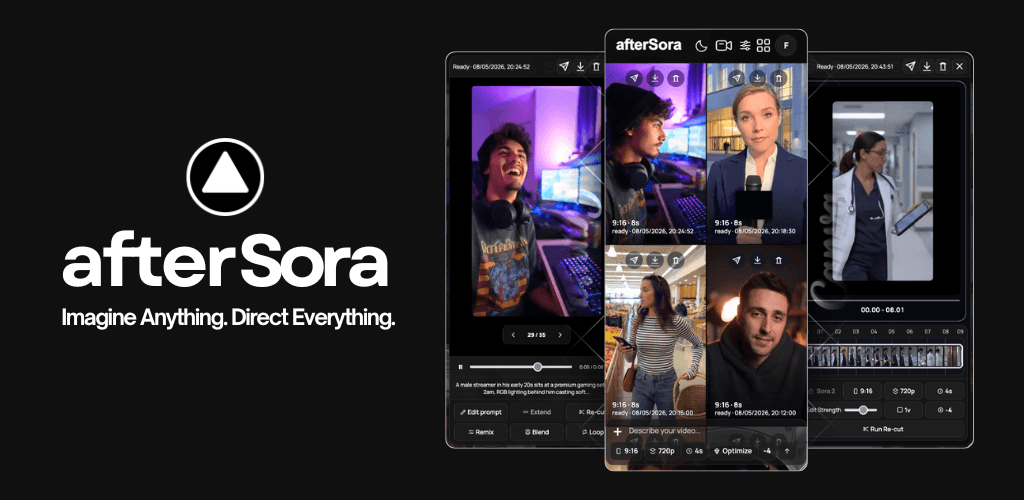
afterSora is strongest when you want one account and credit balance for a structured creative workflow. Runway is a strong direct creative suite; Kling emphasizes advanced video generation; Google Veo is a model and developer-platform choice; Seedance focuses on multimodal, multi-shot generation; and Luma targets highly directed production workflows.
Comparison matrix
- afterSora — best fit for creators who want projects, model choice, reusable characters and worlds, storyboards, editing operations and Rift in one workflow.
- Runway — best fit for creators who want a mature direct suite with text-to-video, image-to-video, task-specific apps and node-based workflows.
- Kling — best fit when a current Kling model and its direct generation controls are the deciding factor.
- Google Veo — best fit for teams already building through Google's model and cloud ecosystem.
- Seedance — best fit for multimodal references and multi-shot audio-video generation where the current regional access route works for your team.
- Luma — best fit for production teams prioritising frame-level direction, keyframes, HDR/EXR and API integration.
How afterSora differs from a direct model tool
A direct model product primarily gives you access to its own generation surface. afterSora is a workflow layer: organise work by project, preserve prompt and reference context, reuse characters and worlds, assemble storyboards, choose supported generation routes and perform follow-up editing operations without rebuilding the project around every model change.
That distinction matters if a campaign needs many shots or several models. It matters less if you only need occasional experiments with one provider's newest release.
Choose by the job, not the leaderboard
- For recurring campaigns: prioritise project memory, references, versioning and predictable credit controls.
- For one difficult hero shot: test the current models with the same prompt and reference before committing.
- For social output: confirm vertical resolution, duration, audio and turnaround in the live product.
- For developer integration: compare API access, regional availability, queues, failure handling and commercial terms.
- For client production: keep original prompts, settings and outputs outside any one provider.
A fair testing method
Use one brief, one reference image and one delivery format. Give every tool the same motion request, then score prompt adherence, subject stability, camera behaviour, usable duration, turnaround and total cost per usable clip. A polished showcase is not a substitute for testing your own work.
Start with afterSora
Review the current feature set and pricing before purchase, because enabled models and limits can change. If your priority is maintaining a reusable multi-model workflow rather than committing to one vendor, create a small test project and compare the output against the direct provider you are considering.